 Safety
Cash & cash equivalents
Best for liquidity, emergency cover, and short-term needs. Weak long-term wealth engine on its own.
- Savings account
- Fixed deposit
- Liquid fund or T-bills
An asset is not just something that can go up in price. Each asset solves a different job: safety, growth, income, inflation defense, or higher-risk upside. This page gives the practical map in plain language and shows the usual ways people actually invest in each asset class.
Most investors get into trouble when they expect one asset to do every job. Use this map to understand what each asset is mainly meant for before you decide how much of it belongs in your plan.
SafetyBest for liquidity, emergency cover, and short-term needs. Weak long-term wealth engine on its own.
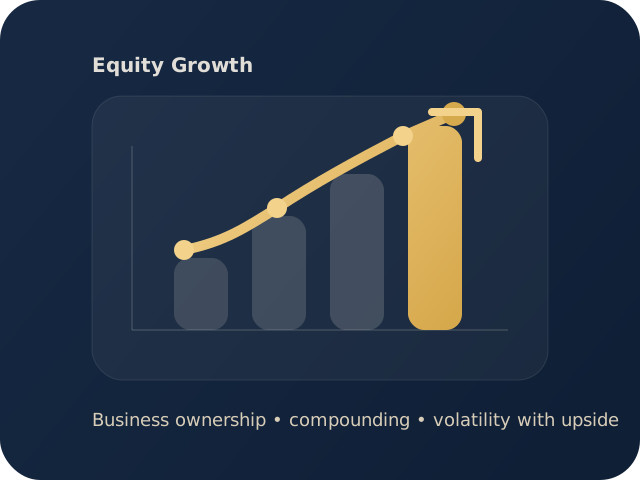 Growth
Best mainstream long-term growth engine. Volatile in the short run, powerful over longer periods.
 Stability
Useful for calmer returns, income, and portfolio balance. Usually safer than equities, but not risk-free.
 Defense
Usually used for diversification and protection, not as the main compounding machine of a portfolio.
 Utility
Useful for rent, location value, and leverage, but usually needs more capital and is less liquid.
 Advanced
Useful for special situations, higher-risk upside, or diversification, but usually not beginner defaults.
Cash-like assets are not exciting, but they stop emergencies from turning into bad long-term decisions. This bucket is usually the first layer of financial defense.
Emergency fund, near-term goals, and capital preservation.
The simplest place for emergency money and day-to-day liquidity. Safe and flexible, but usually weak against inflation over long periods.
Learn moreUseful when you want a known rate for a fixed period. Calmer than market products, but your money is less flexible until maturity.
Learn moreUsed for cash parking with somewhat better efficiency than idle savings in some cases. Still meant for stability, not aggressive growth.
Learn moreShort-term government paper is often used for safety and short-duration parking when investors want sovereign backing and cleaner liquidity.
Learn moreEquity means business ownership. It is usually the part of a portfolio that accepts volatility today in exchange for stronger long-term growth potential.
Long-term compounding, business ownership, and growth that can outpace inflation better than cash over time.
Best for investors who want direct company exposure and can do their own research. Higher control, but also higher concentration risk.
Learn moreA broad-market way to own many companies at once. Usually the cleanest starting point for people who want growth without picking stocks one by one.
Learn moreUseful when you want a professional fund structure instead of direct stock selection. Can be active or passive depending on the fund.
Learn moreTrade on the exchange like a stock while giving diversified exposure like a fund. Useful for index, sector, or international exposure.
Learn moreFixed income is usually used for stability, income, and risk control. It can reduce portfolio drama, but it still needs rate and credit awareness.
Income, smoother portfolio behavior, and lower volatility than equity in many situations.
Usually the cleaner safety end of fixed income. Useful for investors who want sovereign exposure and steadier expectations.
Learn moreCan offer higher yields than government paper, but also bring business credit risk. Useful only when risk is understood properly.
Learn moreUseful when you want pooled debt exposure without building a bond ladder yourself. Quality and duration should still match your purpose.
Learn moreUseful for exchange-traded fixed-income exposure and sometimes for matching a cleaner duration bucket inside the portfolio.
Learn moreGold is usually used more for diversification and defense than for cash flow. The route you choose matters because convenience, storage, liquidity, and trust are all different.
Diversification, stress protection, and inflation-sensitive defense in a broader portfolio.
Coins, bars, and jewellery are the most familiar form. Useful for direct ownership, but storage, purity, and resale spreads matter.
Learn moreA convenience-first route that gives gold exposure through a digital platform. Easy to access, but platform quality and actual backing matter.
Learn moreUseful for investors who want market access without physically storing metal. Usually cleaner for portfolio allocation than buying jewellery.
Learn moreUseful when you want gold exposure in a mutual-fund style wrapper with easier recurring investing and no exchange order flow.
Learn moreIn some markets there are government-linked gold routes that add structure on top of gold exposure. Use them only if the terms and availability work for you.
Learn moreUseful when you want business exposure tied to gold rather than direct ownership of the metal itself. This behaves more like equity than bullion.
Learn moreReal estate can give utility, rent, leverage, and location-driven upside. It can also trap capital, create maintenance stress, and move more slowly than people expect.
Utility, rental income, location value, and an asset people can understand physically.
The most familiar route. Useful for self-use or long-term ownership, but one property should not be confused with a diversified portfolio.
Learn moreFocused more on yield and tenant cash flow. Better suited to investors who can handle vacancy, maintenance, and operational work.
Learn moreListed real-estate vehicles that make property exposure easier and more liquid than buying whole property directly.
Learn moreUseful when investors want pooled property exposure. Quality, structure, fees, and liquidity need extra attention here.
Learn moreSome assets exist for diversification, some for special situations, and some mostly for speculation. The point is not to avoid them blindly. The point is to know their role and not let them become the foundation too early.
Selective diversification, special opportunities, or high-risk upside for investors who already understand the core basics.
Useful for selective exposure to metals, energy, or agriculture. Commodity-linked equities are not exactly the same as owning the commodity itself.
Learn moreAccessible through direct holdings, exchanges, or regulated products where available. Volatility, custody, and regulation all matter heavily here.
Learn morePotentially powerful, but illiquid and highly dependent on selection quality. Usually better suited to experienced investors with long time horizons.
Learn moreThese can be useful in special cases, but they become dangerous fast when bought only because they sound sophisticated.
Learn moreThe same asset can often be accessed in more than one way. Knowing the route matters because fees, liquidity, control, and complexity all change with the wrapper.
You buy the thing itself: a stock, bond, property, physical gold, or direct crypto holding.
Learn moreYou buy a fund or ETF that already owns many assets inside it. Useful for diversification and simplicity.
Learn moreA manager, platform, or product structure chooses and manages the asset mix for you.
Learn moreYou gain economic exposure without fully owning the underlying asset. Powerful, but usually much more complex.
Learn moreYou hold the asset through a special account or retirement structure that changes tax treatment or restrictions.
Learn moreThe asset logic stays similar across countries, but the accounts, wrappers, government systems, and default products do not. Use this as the practical next layer after understanding the asset map.
Use a demat and trading account to access stocks, ETFs, and many market products in one place.
Before buying funds, understand what a mutual fund is, what categories exist, and what role each one can actually play.
Use the official RBI route when you want direct access to government securities instead of only going through a fund wrapper.
Use a proper research workflow before adding more funds or stocks just because the recent chart looks exciting. Morningstar works for both India and USA readers here.
A standard US brokerage account is the basic route for ETFs, stocks, funds, and long-term investing on your own terms.
When you need broader market access, international exposure, or more advanced account capability, use a stronger brokerage setup.
US Treasuries are one of the cleanest official routes for the low-risk part of a portfolio when safety matters more than upside.
Low-cost ETFs are one of the clearest ways to build diversified ownership without picking single stocks one by one. Use Morningstar for research before adding positions.